The 'Emerging' Church and Straw Men
In many disputes and contentious issues arising within the Christian church the failure to define the terms which we employ in debate often lies at the root of our (mis)understanding. The 'Emerging' church is a recent example; but the growing influence of the 'discussion' brings an obligation to understand what it is all about.
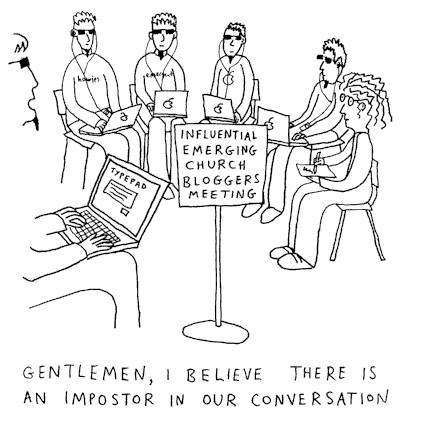
Many of the disputes amongst Christians can be traced back to misunderstandings about the words we use – and especially where poorly-defined neologisms become extensively employed in the cut and thrust of theological debate. In socio-political discussion, one man’s definition of a “post-modernist” might differ from that of his neighbour, but as a ‘shorthand’ term of convenience it is widely used in debate and argument.
In a similar way – and predominantly in the 60s through 80s – the (Capitalised) term “Charismatic” was the common epithet used to describe …. well, what? The gifts of the Spirit? Anything different from tradition? Was it a “Movement”, or a “heresy”, or a “Renewal”?
Depending on one’s position and view, the term was employed as one of commendation or, alternatively, in a pejorative and highly critical sense. To be “Charismatic” was either taken to be the hallmark of those alive to the things of the Spirit or, alternatively, used as a sneer and a stigmatic label applied to the latter-day deviant. And much of the ensuing debate and disagreement stemmed from the fact that the term was never strictly defined. So apples were confused with oranges which were confused with pears.
Of Straw Men
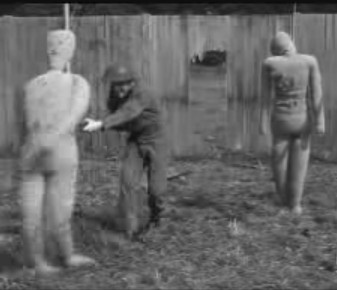 Very often those involved in argument enlist the help of a Straw Man.
[The term “Straw Man” originally derives from the effigy/dummy which was constructed to allow infantrymen to perform bayonet practice on an ‘enemy soldier’.
In debate, it describes the unprincipled practice of erecting a grotesque caricature as a distorted stereotype of that which the antagonist wishes to criticise; and then launching a scathing attack on the gross misrepresentation that has been expediently constructed.]
In the controversy over the Charismatic Movement, it was often the case that extremes (and there were many to pick and choose from) were seized upon as being totally representative of the whole. These were then used to construct the “Straw Man” before wheeling him on stage - only to skewer him on a bayonet of blanket condemnation.
Sadly the “Straw Man” problem could arise with us again.
This time around, the term which is being increasingly bandied about is that of the “Emerging” Church. [“Emergent” is a stream within it; and "Yes" it is confusing.] Again it is a convenient shorthand description of most of anything that represents a change from the status quo.
If we consider all that is ‘new’ there will be found a slew of modernism which embraces a very wide spectrum; and within this spectrum, almost certainly, there will be developments that are positive and biblical but, inevitably, other facets which are less so. Yet this (ill-defined) term is increasingly being employed by supporters and detractors alike – with each focussing on the particular element(s) of the whole scene which supports their respective arguments.
Whilst this situation is obviously and highly unsatisfactory to attempt to define the Emerging Church is like trying to pin the proverbial jelly to the wall.
One game; two courts
 And so the battle could rage – and here it’s “déjà vu all over again” – with the two sides of the debate each smashing the ball back over the net to his (or her) opponent, with neither the players nor the spectators recognising that the former are occupying two separate courts.

With this in mind, it is probably wise to be both very precise and extremely cautious before offering any view on the “Emerging Church”. Both a protagonist and a sceptic might, in the semantic sense, each think that they know what – in terms of definition – they are talking about; but each might, and unwittingly, hold a different conception and definition to that of the other person.
Caution; the enemy is ever at work!
Accordingly, the opportunities for more heat than light are immense. [And who wants a re-run of the Calvinist/Charismatic misunderstandings (whatever these terms mean)?]
So let the debate flow, but let’s be very cautious with the words we employ; and no less so when it comes to things that are “emerging” - an ever-present dynamic.
Footnote:
Thinking disciples of Christ will always seek to understand how best to outwork the eternal and unchanging theology and doctrines of Scripture in the context of a (now rapidly) changing culture and sociological setting. The Emerging Church debate is the most recent manifestation of this dynamic.
Whilst the debate might be difficult, ignoring the issues will not make them go away. The only constant (aside from God) is change; and the concept of the status quo is a myth. 'Semper Reformanda' (always reforming) was part of the strapline of the Reformers: in theory at least, it still is.
-----------------------
Caveat 1: Google "Emerging Church" and you will come up with a myriad of differing views and definitions: further confusion rather than enlightment might ensue.
Add in "John MacArthur" and "Brian McLaren" to your search; but don't put these names in a Search box together or you might trigger an explosion.
If you haven't yet dipped your toe into the issue, here is one starting point. But be aware, it is only one starting point; there are multitudes of others.
Caveat 2: However we "do church" in the 21st century, it might outwork differently in the UK from America; Scotland might "do it" differently from England, the Highlands might differ from the Central Belt and 'rural' will no doubt differ greatly from 'urban'. Stereotyping, mindless imitation and illegitimate comparisons are best avoided.
Mark Driscoll (Mars Hill Church) on "Emerging Church"
Christians Together, 01/02/2009