Christian Life 
 Articles in this group 
We've Lost the Culture War
A comment from across the pond on the [lost] battle to preserve traditional Judeo-Christian values. But it's not just in America that we see these things. More ...
A Strong Letter to the Apostles
As a follow-on to the 'Lakeland Outpouring' Andrew Strom writes in strong terms to the Apostles in North America. More ...
Jean Darnall - a recent interview
Chris Hill met Jean Darnall when she was in the UK in the 60/70s. In a recent visit to America he recorded a 30 minute interview with her. More ...
What is the Spirit saying in and for 2010?
Every believer is encouraged by the Lord of the church to discern what the Holy Spirit is saying to the body of Christ. I don't know about you, but this is where I am at. More ...
Prophesy from Alex Buchanan
David Wilkerson's anguish
A 'word' from an Inverness believer

Don't read this...


by Watchman

Warning sign
Don't  click on any of the links at the foot of this page if you are -

  • overly-dependent on organised churchianity for your status, livelihood or ministry platform
  • prone to knee-jerk reactions
  • enthralled by steeples and stained glass windows
  • unquestionly following all that the church does and teaches
  • convinced that the clery/laity divide is biblical
  • thinking that to grow the church we need to put a bigger building
  • unprepared to 'think outside the box'
  • frightened to 'be a Berean' and challenge some sacred cows
  • believing that all that you have been encouraged to do has a scriptural foundation
  • certain that the Reformation was the be-all and end-all
  • persuaded that the new churches have it all
  • satisfied with the status quo
  • unwilling to let go of some of your traditions
  • suffering from high blood pressure
  • unwilling to have your thinking challenged
  • prone to be upset if every church building in the country fell down
However, if you are prepared to consider there might just be some things which we have accepted uncritically as "truth" that need to be questioned, scroll down this page....


<<< point beyond which entrenched prejudices should not venture.......>>>>


Sorting Out Truth From Tradition
Many Christians take for granted that their church’s practices are rooted in Scripture. Yet those practices look very different from those of the first-century church. The New Testament is not silent on how the early church freely expressed the reality of Christ’s indwelling in ways that rocked the first-century world.
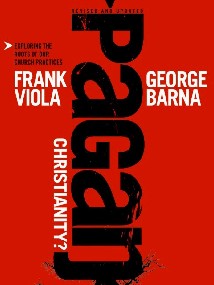
Pagan ChristianityPagan Christianity
by Frank Viola and George Barna

Have you ever wondered why we Christians do what we do for church every Sunday morning? Why do we "dress up" for church? Why does the pastor preach a sermon each week? Why do we have pews, steeples, choirs, and seminaries? This volume reveals the startling truth: most of what Christians do in present-day churches is not rooted in the New Testament, but in pagan culture and rituals developed long after the death of the apostles. Coauthors Frank Viola and George Barna support their thesis with compelling historical evidence in the first-ever book to document the full story of modern Christian church practices.


====

The Nine Lies of Today's Church - by Andrew Strom
[Ed note: the above link is not the original source]

====

Houses The Changed The World - by Wolfgang Simson

====

And if you want to be shocked further you can read how Columba and his associate's Celtic Christianity worshipped on a Saturday.....the Sabbath.
(Ref: The Historical St. Columba in Edinburgh by Dr. W.D. Simpson et al).

====

Ed footnote:
Other links were also supplied, but the above are broadly representative.
You are free to leave any other references or comments below.
 

Watchman, 05/05/2008

Feedback:
Alan25/08/2008, 10:19
"The Nine Lies of Today's Church - by Andrew Strom"

I agreed with 3 of the 9 points and found the rest to be hysterical and verging on pointlessness.

1) The Sinners Prayer should include the ingredients of 'what to do' if you have no idea how to approach God for salvation. I prayed such a prayer and had an incredible experience with Jesus. To suggest that those who rely on such a prayers are 'not saved' is a hugely presumptuous at best.

2) Church buildings? The author obviously doesn't live in Scotland! Houses are too wee and the weather is too bad for open air meetings. I don't believe in spending outrageous amounts but a roof and four walls are good! Gives the community a focal point too.

3) "The "one pastor runs everything" model is totally unscriptural."

Yes I agree, but have you tried getting anyone to do anything? Volunteers apply within!

4) "Tithing" is not a New Testament practice at all."

I have been truly blessed 'by God' since I began tithing! Tithing is a universal principle and even Abraham was blessed because of it and that was prior to the law! So it's not just a 'law' thing.

5) "The words "prosper" or 'prosperity' was NEVER used by Jesus at all"

You cant throw the baby out with the bath water. Just because some folk thrive on greed, does not mean this principle is to be chucked out. Is the author trying to say God does not 'prosper' people financially? I could name a half a dozen folk who are very wealthy Christians - and good folk into the bargain. All good and perfect gifts come from God!

6) "There were no Bible Colleges, Seminaries or degrees in the New Testament."

I kind of agree with this to a point but still there is plenty of occasions in the NT where biblical instruction is given and offered?

Matthew 26:55, Matthew 28:19, Mark 6:6, Acts 5:25, Acts 5:42, Acts 13:1, Acts 18:11, 2 Timothy 3:16,

Just my opinion of course!
John Parker25/08/2008, 13:09
Alan, you said:
"I agreed with 3 of the 9 points and found the rest to be hysterical and verging on pointlessness."

I'm sure that you can do better than that (smile).
What you seem to be saying is that you agree with what you agree with, and what you don't agree with is to be dismissed as off the wall or irrelevant.

I haven't gone through the article you refer to in detail but regarding your points above -

1. Surely we need to be careful about how we use words and scripture? Repent (of your sins), believe (in the Lord Jesus Christ) be baptised (as a believer), receive (the Holy Spirit). These are all biblical concepts using words from the Bible. If these are incorporated into a "sinners prayer" then that is fine. But "give your heart to the Lord" can mean whatever a person wants it to mean.

2. The early Christians met "from house to house and in public places". How much of Christian giving in spend of erecting and maintaining building? How much is (present and future) giving tied up in paying mortgages for grand structures? In the Bible the word for which is translated as "church" is NEVER used to describe a building. It means a "gathering of believers". And for bigger gatherings what's wrong with schools and village halls (which many find perfectly adequate)? Of course it's when you get into the megachurch (big is better than small) that you need a cathedral.

3. Are you saying that in the face of error we should just accept the status quo because there doesn't seem to be an easy alternative?

4. Re "tithing" the reason that it is unbiblical is because Jesus doesn't want a mere 1/10th: he wants everything (c/f Luke 21:4).
Tithing (if externally enforced) is legalism. God loves a cheerful giver. If someone is led that way and is blessed through it, fine. But let's not make it into a law (along with the other 613 OT requirements.)

5. The point being made re "prosperity" is (I think) a counter to the "name it and claim it" prosperity preaching. Yes, of course there are wealthy Christians - and not-so-wealthy ones also.

6. Again I think the point being made is not-so-much an argument against being "taught" rather than against mere academic knowledge being a prerequisite for ministry (and I mean "ministry" as the Bible defines it, not in the way men have distorted the meaning).
Alan26/08/2008, 00:18
I'm glad someone picked this up.

1) "But "give your heart to the Lord" can mean whatever a person wants it to mean."

I didn't actually call that a sinners prayer, he did give 3 options and that was one of them and the sinners prayer was another. Jesus taught His disciples to pray, surely we can teach others to pray.

2) Properly governed and reasonably attended churches should not use general tithes and offerings for building work. But should have a seperate building fund.

Also, why should the church use public buildings that could be also occupied as mosques, witchcraft-fairs, gay wedding receptions etc. Like our church, the building was put up by miners in the 1930's on a bit of land that was given at a nominal rent. The manse was similarly built and the bricks donated by another pastor. My point is, the church should have a place but the only folk who can pay for it is the 'church' itself. Not by mortgage but by saving up.

3) Why is it an error to accept the status quo if there is no alternative? What would you do, shut the church down?

4) When did tithing get abolished?

5) True meaning of prosperity in the Bible is to 'not suffer loss'. It is only partly to do with finances. But the author was talking about the money side.

6) By the way, I agree with you on that but the author made a sweeping statement and was unclear. He also used the word disaster. Think of the disaster if the pulpits were not protected?
Iain L (Guest)26/08/2008, 12:16
Regarding (6) whilst a good theological education is an excellent thing, unfortunately it has two very unhelpful effects -
1. it tends to de-bar very well (biblically)versed 'lay people' from the teaching and preaching of the word
2. it fails to "protect" the pulpits (which, amongst the sound ones, are full of unconverted, liberal and heretical clergy)

The net effect of these two problems is that believers are denied hearing what they should hear and exposed to things that are very harmful.
Alan26/08/2008, 14:22
I agree with that Iain. The famous or infamous William Barclay who was Professorship of Divinity and Biblical Criticism at Glasgow Uni did not believe in the Virgin birth of Jesus. Yet he was the Prof overseeing the Kirk's ministers education.

Also, I have came across many career ministers. I have a friend in NewYork who is now a prominent Anglican but was actually converted at Seminary. So he was actually becoming an Anglican priest with no real experience of God.

But, we should educate those who have a calling and the calling is recognised by the church.
Iain L (Guest)26/08/2008, 16:07
I think that we should all aspire to be Biblically literate. Some of the most educated men in Brethren circles (of a generation ago anyway) were miners, tradesmen, etc who took the trouble to study the Scriptures. Nowadays many believers look to 'get by' on a daily devotional and the Sunday sermon.

Leaving aside the issue of unregenerate clergy, even within the evangelical camp the problem is that the 'pastor/teacher' roles have been (a) professionalised and (b) inseparably joined.

Yet there are many pastors (by gifting and calling) who are very poor preachers - end vice versa.

Similarly there are many (laity so-called) who are gifted as pastors and/or teachers who are required to keep silent in the pews.

Everyone knows these things, but no-one at leadership level is prepared to say it or even less do anything about it: there is too much to lose.